Tinyang was driving the camera today while I managed to record this video of the male Gold-Fronted Woodpecker.
She took this wonderful shot too. Congratulations, tinyang!

Tinyang was driving the camera today while I managed to record this video of the male Gold-Fronted Woodpecker.
She took this wonderful shot too. Congratulations, tinyang!
I’m a sucker for a crisp closeup. But blurry can be okay, too, if it’s part of a great action photo. Like these: My favorite action photos from the past few weeks.
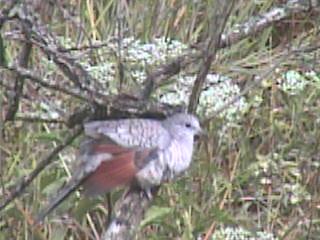
Inca Doves are looked down on by some birders; “trash birds”, I’ve heard them called. Maybe I’d feel that way if they lived in my neighborhood, but they’re still kind of exotic to me. Anyway, I make it a point to try not to look down on any bird. Why, I’ve even managed to make myself be interested in starlings, if you can believe it. But however you feel about Inca Doves, you have to admit that if you catch them at the right moment, their wing linings are pretty.
Like in this shot that eyes23blue took back on October 15:

And this shot that tinyang took a few minutes later:
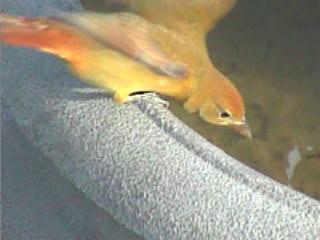
If you want pretty, check out this beautiful shot of a Summer Tanager that rafa took on October 17:
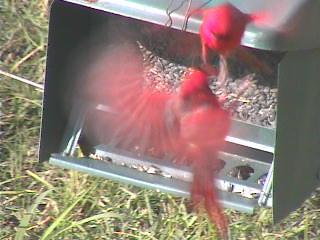
blether (a fairly new user, I think? at least, one I haven’t noticed much before now, but maybe that’s because I’ve only recently been spending more time on the camera after a period of neglect) got this amazing photo of two male Northern Cardinals going mano a mano on October 21. I think this might be my favorite action photo ever:
Finally, it’s kind of hard to see what’s going on in this one, but if you squint just right at this shot by avatar99 from October 22 you can make out the Barred Owl launching off the end of the T-bar. Look out below, mousies! 🙂
Congratulations to everyone who caught these amazing moments.
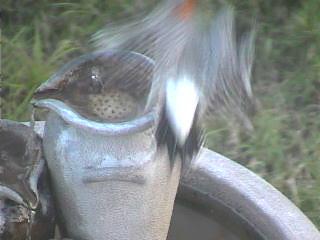
Update: I overlooked this neat shot of a Golden-fronted Woodpecker. It was taken by avatar99 on October 23:
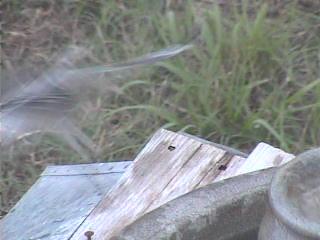
Later update: txbird got this great shot of the Northern Mockingbird on October 25:
The first view I ever had of CONE Welder was the following zoomed-out panorama:
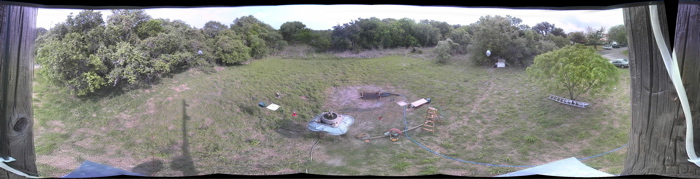
And then there’s that complicated-looking circular object near the center of the field of view. What is that thing? A feeder station? I really want to zoom in on it to get a better idea.
As we all now know, that thing was actually the fountain, with its inverted-cone squirrel guards (I guess?) around the support legs.
For a long time I mostly neglected the fountain; there didn’t seem to be much happening there. I was much more interested in the feeders, and the pond, and that bare-limbed tree beyond the pond to the right. But lately there have been a lot of good birds being photographed at the fountain. Here are some of my favorite shots from the last few days:
The Eastern Bluebird seems to show up here regularly. Here’s a really nice view (of a male, maybe? not sure), taken by txbird at 1:17 p.m. on October 20:
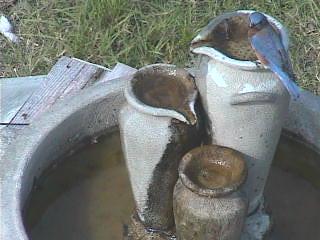
Here’s a two-fer: A Green Jay on the left, and an Audubon’s Oriole in the middle. We’ve only seen Audubon’s Oriole a few times with the camera, so this was definitely an exciting appearance. This shot was taken at 6:49 a.m. on October 21, also by txbird:

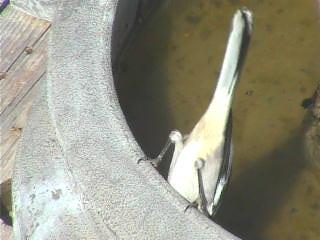
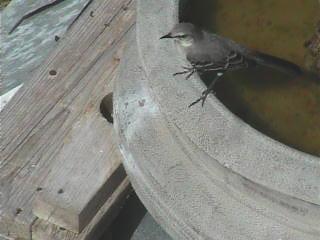
Next up are several shots of the Northern Mockingbird, a bird we’ve seen off and on for a while, but have seen a lot of lately at the fountain. The following shots are by, in order, rafa, idbirds, vanilla and tinyang. If you check out the inner toe on the bird’s left foot in each shot, you’ll see that there are at least two mockingirds visiting the fountain: One who is missing that toe, and one who isn’t.


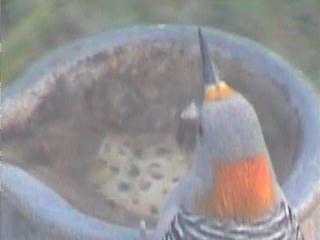
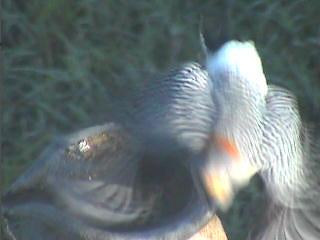
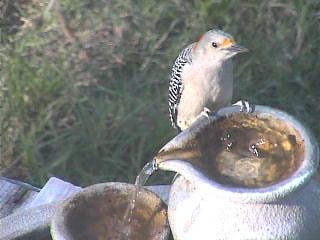
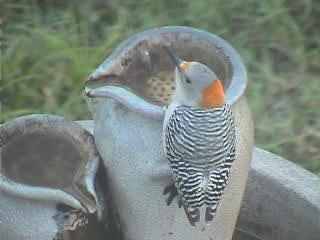
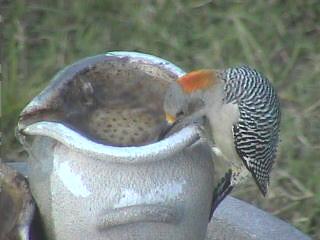
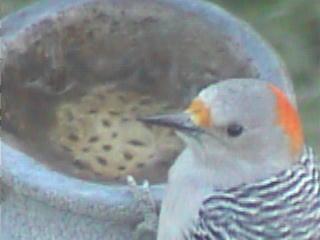
Finally, here are a bunch of my favorite shots of the Golden-fronted Woodpecker, a bird we’ve seen only a few times before its recent run of fountain visits. These are by idbirds, txbird, vanilla, txbird, rafa, and txbird, respectively:
I was chatting recently about all the great fountain shots lately, and wondering if there really are more good birds at the fountain these days, and if so, what caused the change. Or is it that there have always been these good birds there, and we’ve just never bothered to look? I could see an argument being made either way. Birds change their habits in response to seasonal movements and shifting food and water sources and any number of other factors. We’ve certainly seen dramatic changes in the birds visiting the feeders over a similar span of time. So I could easily believe that this recent run of interesting birds at the fountain really is a new phenomenon.
On the other hand, I’ve always been suspicious of the unavoidable tunnel vision imposed by the CONE system. With no peripheral vision and no audio cues, and with the constricted field of view when the camera is zoomed in, birdwatching with CONE Welder is a little like a deaf person birding with his or her eyes constantly looking through binoculars (or rather, a spotting scope, and a spotting scope restricted to sweeping through a fairly limited arc in terms of side-to-side motion, and an even more limited arc in terms of up and down). When I try to imagine what it would be like to bird in that fashion, I’m struck by the realization that there could be all kinds of interesting birdy activity going on just outside the frame, and I would simply never be aware of it.
Something I thought about several times with the old CONE SF system, and that I think about now with CONE Welder, is that I’d love to actually be there with my binoculars and a network-equipped laptop, birding the area conventionally, and comparing what I see and hear to what is being found and seen via the camera. As with that shot Chris forwarded to us of the Red-shouldered Hawk perched high in the bare tree (who even knew that there was a top portion of that bare tree?), I suspect I’d find that there is a lot going on that is being missed by the camera.
I think there’s a larger philosophical lesson there. Something I’ve definitely learned from birding is how the process of becoming a better birder is not just about becoming more knowledgeable. It’s about becoming more aware. For all that I really love the CONE system, it’s important to be aware of its limitations, and one of its biggest limitations, I think, is that tunnel vision it imposes.
But constrained as it is, it still offers an amazing view into the birds at a place that I otherwise would not be able to see at all. And these latest shots from the fountain are a great example of that. Thanks to everyone who made them possible!
Here are some of my favorite shots from the last few days:
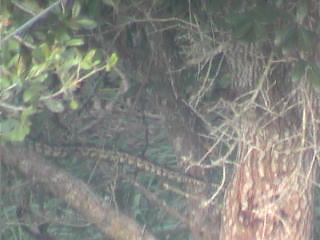
birdbrain got this great shot of a snake (a diamondback rattlesnake, maybe? any herpetology experts want to chime in?) back on July 30:
After a long dry spell, several users have taken photos of Wild Turkeys lately, including this shot with two turkeys by kryptonkay on July 31:

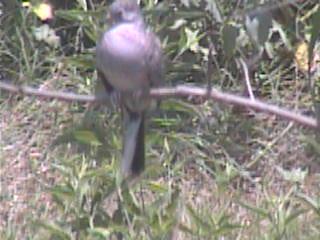
Today (actually, yesterday now; August 1), tinyang got this shot of a bird that’s a real mystery for me. I’m really not sure what to make of it. An Inca Dove in an unusual body position, maybe? Are those white feathers on the tail?
Several photos were taken yesterday of a female Cardinal feeding a begging Bronzed Cowbird, including this great shot by rafa:

I didn’t realize that Bronzed Cowbirds were nest parasites, just like Brown-headed Cowbirds, but according to Wikipedia, all cowbirds are nest parasites. So it looks like this is a shot of a fledgling begging for food from its adoptive mother.
Look what Hurricane Dolly blew in this morning: CONE Welder’s first warbler, a beautiful Prothonotary photographed twice by idbirds:


Congratulations, idbirds!
Update: I should mention that we previously got a shot of what I think was probably a Louisiana Waterthrush. But it was never ID’d, which makes this the first official warbler in the game.
It had been the rarest bird in the game, I believe, in terms of number of successful IDs, with just one image, this one, taken back on May 18 by birderbf:

But then yesterday birdbrain and txbirds got the following two shots on the tray feeder:

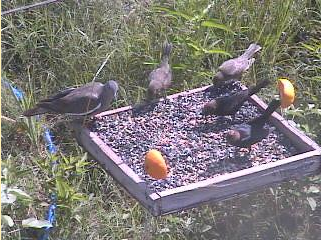
And today the following three shots don’t yet have IDs, but I’m pretty sure that’s the same species. These are by leacox, birdbrain, and anneelizabeth:
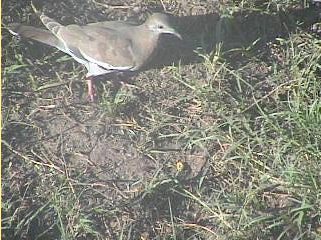

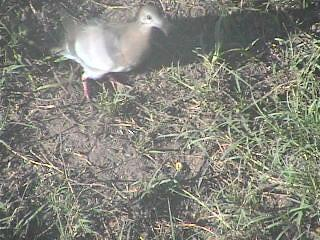
That last one by anneelizabeth is really interesting; I think it might be a blurry video capture of the bird opening its wings. Cool!
Here are some shots from today of what looks like a new bird for the game, at least if we can figure out what it is. These four shots were all by txbird; either no one else was on the system at the time, no one else was paying attention, or no one else had any shots left:


It’s clearly a flycatcher, and the overall color pattern says Myiarchus to me. If I were seeing this bird around my Southern California home, I wouldn’t even wonder; I’d call it an Ash-throated Flycatcher and be done with it (which I realize is a little bit bogus; rarities happen, after all). But in the south-central Texas environs of CONE Welder things are more complicated.
Sibley shows three species of Myiarchus flycatchers near CONE Welder in the summertime: Ash-throated, Brown-crested (which is a species of interest in the shifting-breeding-range study), and (maybe) Great Crested. The Welder checklist gives the following:
| S | S | F | W | |
| Ash-throated Flycatcher | R | U | ||
| Great Crested Flycatcher | O | O | ||
| Brown-crested Flycatcher | R | U |
The three species are quite similar-looking, and even though we’ve got a number of excellent shots here, I can’t say that I’m confident based on appearance which one of the three birds to call it. But overall I guess if I had to pick something I’d pick Ash-throated Flycatcher: It looks as much like that to me as it does either of the others, and the Sibley range map and the Welder checklist both agree that it’s unambiguously there in summer. But I really don’t know.
I’d definitely be interested in whether Dr. Glasscock has any opinion about this bird’s ID. And of course, it goes without saying that I’ll be watching closely to see if we can get any more shots of this very interesting bird. Thanks, txbird, for doing such a great job on the camera!
rafa got a single shot early this morning of what has been ID’d as a Yellow-billed Cuckoo. Check it out:

Apparently the bird was moving around too fast for rafa to get a closer shot. Here’s a magnified version of the one shot we have:
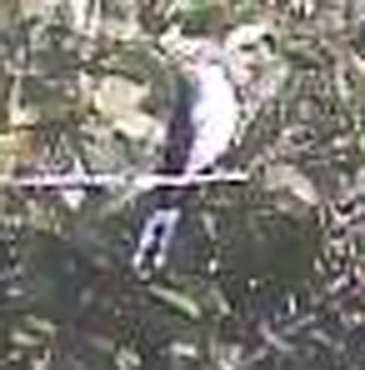
Zoomed in like that, and checking the field guide (which I have to do, since it’s a bird I don’t know personally), I’d say there’s no question. I can barely make out the bird’s beak, extending to the left, and the dark marking around the bird’s left eye. The markings on the tail, and the overall shape and coloration, are perfect: It’s an adult Yellow-billed Cuckoo. Fits the Welder checklist and the Sibley range maps, too.
Great bird! Thanks for being alert on the dawn patrol, rafa!
Here are a few of my favorite shots from the last few days.
On the night of July 3, avatar99 got what I think is the best shot so far of the Barred Owl:

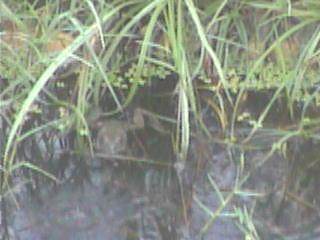
A number of us have been getting shots of frogs in the pond. Here’s a nice one taken on the Fourth of July by leacox:
Finally, this afternoon rafa got a couple of shots of the male Painted Bunting that I think are the best shots anyone has obtained of him with CONE Welder yet:


Those are pretty spectacular, but if you want some real Painted Bunting fireworks, check out these two shots that user Sabine on the Steve’s Digicams site uploaded back on July 1:
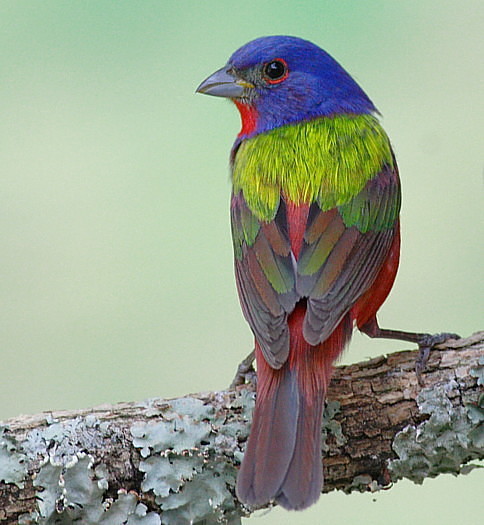
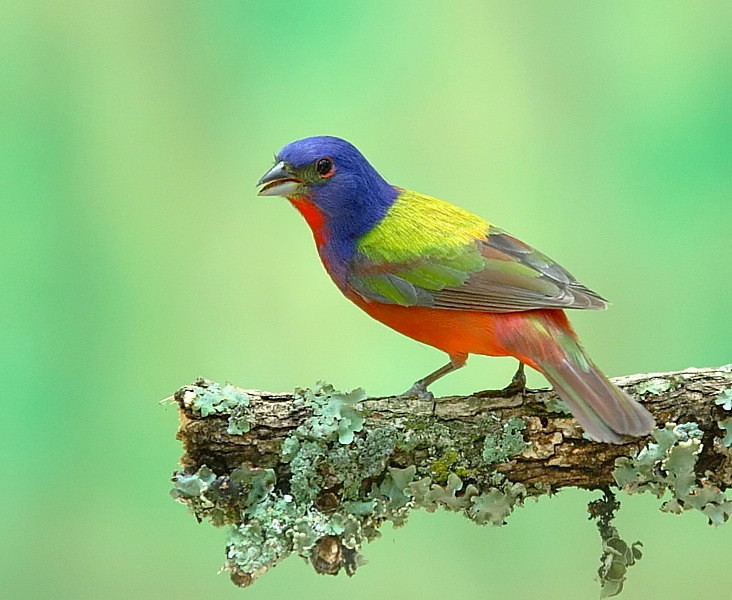
I really love the views we get with CONE Welder, but it sometimes takes a shot like these, or better yet, a trip out in the field with my binoculars (like the visit I paid this afternoon to the Carpinteria Bluffs, where I got to watch a Black Oystercatcher bathing in a tidepool), to remind me of how neat birds really look.
We were having fun this morning trying to figure out the following “mystery bird”. rafa got a shot at 6:10 a.m. in the dead tree (which really seems to be a magnet for great birds):
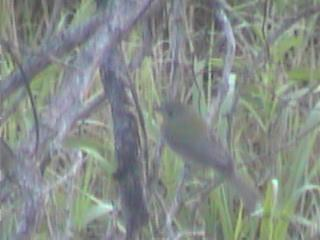
Later, it showed up several times on a particular plant just above the water fountain. At first I was thinking it might be a Myiarchus flycatcher. But when it came back and we got some good looks at it (including seeing it feeding on the plant’s seeds) I abandoned that idea pretty quickly.
Here are the two best shots I got (I kept a few others, too, and I haven’t seen yet what the other users got, since their shots are still embargoed):
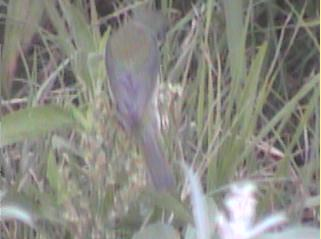
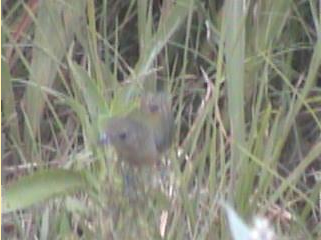
I’m pretty comfortable calling this a female Painted Bunting. There’s a delicate beauty to the markings of female buntings that I really like. They’re not as showy as the males, but I like looking at them.
Update: Here are my favorites of the images other users got. anneelizabeth got this cute shot:
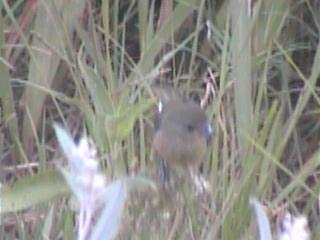
And birdbrain got this great action photo: