Archive for May, 2008

Camera Issues Again?

Friday, May 16th, 2008

I can log into the CONE Welder site, but clicking the power button on the camera never turns it on. I also can’t see any users (including myself) showing up in the left pane of the chat window. My guess is that this means we’ve got a problem at or near the camera, or at least something toward the lowest, “camera” layer of the stack of components that makes up the system.

The last image in the gallery was timestamped 12:31 a.m. So the problem apparently occurred some time after that.

Update: Bryce sent me the following via email a few minutes ago:

Hi John,

I just saw your blog post. There were thunderstorms around the camera site last night and we believe something happened to the camera connection there. We are looking into it as I write this and I’ll keep you updated. Thanks!

-Bryce

Later update: Bryce emails again to say the camera is back up again. I’m at work, so I can’t play. Wah! :-)

Interesting Hummingbird Shots

Tuesday, May 13th, 2008

Check out these two hummingbird shots taken yesterday around 8:15 a.m. by rafa and bryce, respectively:

They’re not great shots, and the lighting may be playing tricks on me, but they certainly give the impression of a white belly and buffy flanks. I could see that being a female Rufous Hummingbird (which the Welder checklist lists as “rare” in the spring), or a female Broad-tailed (which the Welder checklist doesn’t mention at all, but which seems like a possibility based on the Sibley range map). I’m not sure enough from these images to advocate for any particular ID, but I thought the shots were interesting. Keep checking out those hummers!

Gobble Gobble!

Sunday, May 11th, 2008

There were some great shots of the Wild Turkey today. Here are my favorites, by vanilla and kryptonkay, respectively:

Orchard Oriole

Sunday, May 11th, 2008

We’ve got a new ID in the game today: Orchard Oriole.

This image of what I think is a first-year male was taken by rafa on May 10 (yesterday) at 11:36 a.m. There were several others, some of which showed a second bird that I’m assuming is a sibling of this one. This is the clearest shot in terms of showing this bird’s two distinct wingbars, which I’m thinking (based on Sibley) are the field mark that best helps distinguish him from a first-year male Hooded Oriole.

Congratulations, rafa!

Nice Grackle Display Sequence

Saturday, May 10th, 2008

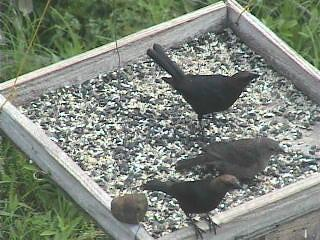
I really like these two shots txbird got this morning of a male Great-tailed Grackle showing off:

Craig’s Black-headed Grosbeaks Are Back

Saturday, May 10th, 2008

The latest post on Craig Newmark’s personal blog: My black-headed grosbeaks are back!

kryptonkay also pointed out this item he posted the other day: Butterball the hawk is back!

We don’t get as many shots from Craig’s deck these days, but the ones we get are really nice. In a way, it’s like we never really lost CONE Sutro Forest. We just got a dramatic upgrade in the camera’s command-and-control subsystem. :-)

Interesting Behavior

Friday, May 9th, 2008

Identification challenges are fun, but observing behavior is even more fun.

I posted an item the other day about the Green Jay spreading its feathers out in the sun (see Odd jay behavior). I likened it to “anting” (the behavior where birds will spread their feathers on an anthill, or even pick up ants and rub them on themselves), but after a little googling of the subject I guess it would more properly be referred to as sunbathing. Lots of birds do it, perhaps to control mites and other parasites.

Here’s a shot that vanilla got today of a male Red-winged Blackbird sunbathing:

There was a comment of “poor thing” on the photo, but I think the bird is probably fine.

As long as we’re looking at redwings (and let’s face it; with CONE Welder we end up looking at redwings a lot), check out this shot that txbird got of three male redwings engaging in display behavior. Nice epaulettes, eh?

Birds aren’t the only things on the birdcam engaging in interesting behavior. The last few nights we’ve had fun watching this raccoon demonstrate his high-wire skills getting onto and off of the feeder. There are some occasional dicey moments, though, like in this shot by whereismyrobot:

Another behavior that users have been commenting on is the display posture that the male Great-tailed Grackles adopt when they’re trying to look impressive. Here’s a great shot that txbird got May 8 at 3:40 p.m.:

Three minutes later, vanilla got this shot of two males posing, with a female on the right side of the frame:

Actual mating is a behavior I don’t remember us ever getting a shot of during the seven months CONE SF was active, but earlier today thedevilbird and txbird both snapped the same shot of a pair of Inca Doves mating. Here it is:

According to the comments the male dove from that pair is the bird in this shot, taken shortly thereafter by robin54. You can barely make out what appears to be an orange band on the bird’s right leg:

Thanks to everyone for getting these amazing shots!

More Shots of the “Mystery Dove”

Friday, May 9th, 2008

We just got some more shots of what I’m pretty sure is the same odd-looking dove I posted about yesterday. This is the dove I speculated might be White-tipped, but which Dr. Selma Glasscock of the Welder Wildlife Refuge said she thought was probably a Mourning Dove. Here are the shots I just got; I’ll update with any different shots obtained by other users when the images move out of the one-hour embargo:

Update: Here are three more shots. These were taken by robin54, txbird, and txbird again, respectively:

So, what do we have here? I have a real hard time seeing “Mourning Dove” in these. It it’s a Mourning Dove, something really unusual happened to its tail. I guess that’s possible, but I’m also not seeing the dark spots on the wings, and overall it doesn’t seem slender enough for me.

Look at the fourth shot of the initial batch (the ones taken by me). Is that a white corner on the tail? I think I’m seeing that, which pushes me in the direction (again) of either White-winged or White-tipped. The dark wings contrasting with the lighter body make me think White-tipped, but then again, maybe that’s an illusion caused by the foreshortened view we’re getting. And is there a hint of white under the edge of the wing, especially (again) in that fourth shot by me? The overall color seems more White-winged than White-tipped to me, at least judging by the illustrations in Sibley, but the head markings, especially in that last shot by txbird, seem more consistent with White-tipped.

I don’t know either of those birds from direct observation, so I hesitate to try to call this based on the available images (especially with Dr. Glasscock, an on-site expert with a long history in the area, disagreeing). But I am familiar with Mourning Doves, and I’m having a really hard time interpreting these shots as being one of those.

I’m interested in what others think.

Later update: After googling for photos on the web, I can see that White-winged is right out; the white border on the wing would be clearly visible if this were White-winged. And I’ve found several photos of White-tipped that look an awful lot like this bird.

Even later update: Dr. Glasscock posts in the comments that after seeing these latest shots, she’s changed her mind, and thinks these (and those earlier shots) are in fact a White-tipped Dove. Woohoo! Now let’s see if we can get an official ID in the game.

Still yet later update: The first image I took (the one showing the dove from the back) has now received enough votes to be ID’d as White-Tipped Dove. Yay!

Black-chinned Hummingbird?

Friday, May 9th, 2008

Check out these two hummingbird shots from yesterday afternoon. First is a shot by whereismyrobot, taken at 4:38 p.m.:

This one is by avatar99, taken at 5:51 p.m.:

These look a lot like the male Ruby-throated we’ve seen, except for that strip of blue along the bottom of the gorget. I can’t figure that out at all.

Is that color really there? Could it be an odd artifact of the camera’s response to the bright iridescence of the gorget? I’ve seen some odd camera effects relating to color in the past, but I’ve never noticed anything like this. But if that color is real, that’s a really unusual-looking hummingbird that I can’t match up with anything in my field guide.

Update: I just noticed that two other shots from yesterday have now been classified as Black-chinned Hummingbird, and that makes me wonder: Could this blue we’re seeing in the above shots be the camera’s response to the black-and-purple of the Black-chinned’s throat? (Later update: Oh, and vireo wondered the exact same thing in a comment posted at the same time I was entering the above update.)

Here are the two shots that have been classified as Black-chinned. I’m not sure I agree that they’re definitive, but they’re certainly interesting, and the second shot, especially, has me leaning in the Black-chinned direction. Both shots were by birdbrain, from 6:03 p.m. and 6:08 p.m., respectively:

Anyway, congratulations birdbrain!

Online Checklist of Welder Birds

Thursday, May 8th, 2008

I’ve made an HTML version of the checklist Dr. Glasscock forwarded to me. You can view it here: Checklist of Welder Birds.